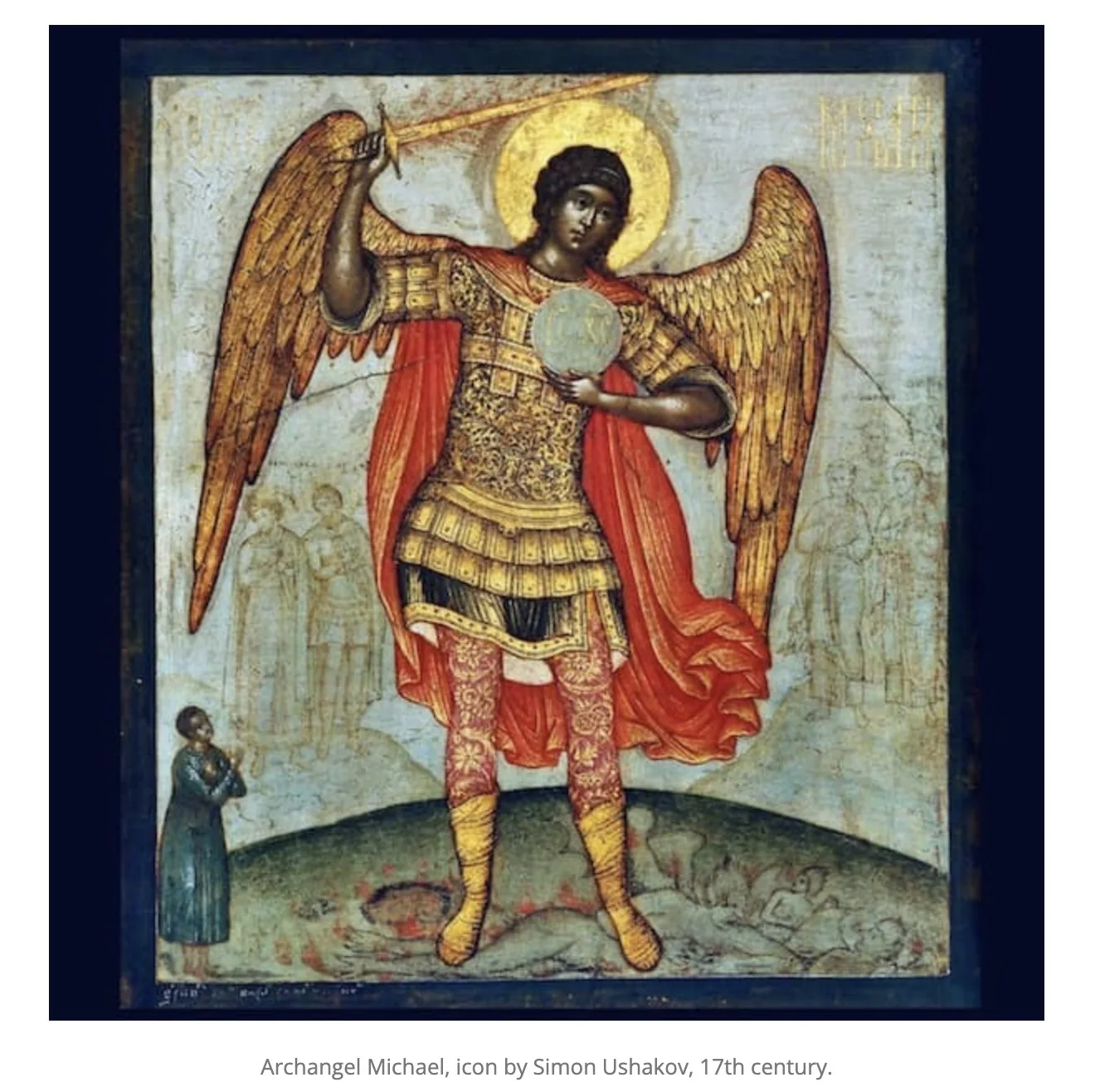
This morning I woke up quite early thinking about Michaelic thinking - a way of symbolising and characterising the emergent consciousness that is simultaneously available to us along with the deficient materialistic thinking of the current epoch that is singing its swan song, to great and terrible effect (these are not my ideas, but a synthesis of Rudolf Steiner and Jean Gebser's epochal views) - an insight landed, as a question:
Could Michaelic thinking be understood not primarily as thinking about spiritual reality, but as thinking that has become sufficiently individual, free and alive that it can enter the world as a love-motivated-deed, whilst also learning from what the world gives back?
This is in many ways a synthesis of my previous written explorations of living thinking, the behaviour trail, integrity, the Saturn Path, and the distinction between possessing spiritual knowledge and making something real through it, and this piece is an exploration-as-I-write.
With this frame I will now fill in the key terms/figures, and then see where this takes my thoughts.
Defining Michael
I think the first set of parameters and assumptions need stating clearly, and readers who cannot digest these notions need not go further.
I take ideas from Steiner such as spiritual beings and 'archangel of our time' (which is how he describes Michael) as hypotheses not dictums. Having spent decades working through what Steiner wrote, what my parents gave me (plus my Waldorf education) and what I experienced from the Anthroposophical community, I have come to see (through experience) huge truths in what he brought, and also huge misunderstandings and misinterpretations of things that he said - so whilst I am simply too stubborn in my sense of freedom to simply accept them because Steiner said, I have come to trust my sense of truth for what he suggests. So Michael can be just a symbol if you prefer, or a spiritual being, if you are willing to go with Steiner a bit more - whilst still retaining criticality (as he actually asked his readers to do). I find it fascinating that Jean Gebser came to a similar epochal view of a developing human consciousness to Steiner's (similar in essence rather than terminology) from studying linguistic and cultural development. Sri Aurobindo also echoes these thinkers, although I will focus on the preceding two in this article for clarity.
So how is Michael characterised? In GA 233a Steiner characterises Michael as an unusually silent spiritual being. Unlike other Archangels who gave humanity impulses towards action, Michael leaves human initiative free. First of all, to relate this to the preceding ideas, both Steiner and Gebser describe the epoch we are living in as a transition from the 'deficient' tailings of the mental-rational (materialistic / modern) epoch, into the emergent 'integral' / 'Michaelic' era. For Gebser, this involves integrating the earlier structures of consciousness rather than simply replacing them. Both see the preceding/current epoch as a necessary step of disconnection from the spiritual world/dimension in order to gain individuality and freedom. Both suggest that the terrible throes of the ending era of materialism are best mitigated not by amassing numbers, but by the intensity of living of those that can connect to what is trying to emerge.
Michael (this is still a topic I am researching, so I am open to corrections here) is a very interesting being. Steiner calls Michael:
“the true spiritual hero of Freedom”
In GA 233a, Lecture 6, 13 January 1924, Steiner makes three remarkable claims (paragraphs 25–26 in this translation):
- Michael does not reveal himself unless human beings bring something arising from their own spiritual work.
In other words, our spiritual perception and insight need to find expression in our doing, with the intention for it to be as it is espoused to be. - Michael is concerned with the consequences of human deeds, rather than initiating those deeds.
For if he were to be involved with their founding, we would not be acting from a place of true freedom. - When people act out of inner freedom and spiritual activity, Michael takes the results of their earthly activity forward into the cosmos.
This points towards a core aspect of 'living' or 'Michaelic' thinking — the integration of thought, feeling and doing.
In The Michael Path to Christ (25 December 1919), Steiner further explores this relationship between Michael and human spiritual activity. As I read these accounts together, a movement emerges: from received authority towards individual freedom and initiative; from abstract intellectualism towards living thinking; from isolated spiritual development towards social creation; and from waiting for guidance towards taking responsibility for our deeds and their consequences.
Spiritual insight is no longer simply something to acquire or understand, but something to bring into life through our thinking, feeling and doing.
Thinking through the implications
Michael is interested in outcome. It's not that Michael is unconcerned with initiation, but rather that he leaves that part to us, as to do otherwise would be to impinge on our freedom. So the important question in developmental terms is then: where does the impulse for action come from? And behind that, what is our rationale for action? What is our theorising?
That theorising doesn't have to be academic. It is our own individual sense-making and meaning-making system, inherited as well as developed through life experience. What underpins all our notions of truth and the certainties constructed upon them? Michael is concerned with what we do with that - the outcomes of our doings suggest to us where our rationale-for-action really comes from - and so the two intertwine in a participatory journey towards wholeness.
Our individual impulses arise from what we make of our cultural and family conditioning, our learning, our communities and, most of all, our individual I: our conversations with ourselves, our self-observation and our lived experience. Out of all of this, if we can find our own identity and sense of freedom, and from that place find motivation and love for our doings — I hesitate to say work, because of its connotations, although I mean work in its deeper sense — and if that work brings enlivening, positive, future-oriented acts into actuality, then Michael can become involved.
The only way we can truly contribute to this aspect of evolution is to develop the capacity to act from a truly individual point of right intention — which comes with very honest self-reflection, as well as lucid awareness of what drives our rationale-for-action (construct-awareness, or knowledge of the epistemology behind the ontological claims that one holds as true for self and world).
I find that profound. Do we have the courage to turn our spiritual opinions, insights, theories, stories and myths into tangible action that others can see, feel and benefit from? Because then we begin to receive what another part of us has been thirsting for. And it comes in through the back door, not the front. Michael begins to bring confidence, resilience, joy, laughter and love in one's doings, from a place we might not even have known existed.
We don't contribute much by bringing profound truth-claims or developing esoteric knowledge and perception per se - only when we act from these.
This needn't set spiritual study and perception against action. Steiner also describes spiritual cognition as an activity in its own right. The distinction here is not between thinking and doing, but between possessing an insight and bringing it into a living relationship with the world. The two feed each other, but the emphasis shifts from becoming the perfect student to becoming a better do-er - and the meditations and knowledge help with that.
What I have found, which is affirmed by Steiner and a later student of his Bernard Lievegoed, is that by acting first, before one feels spiritually ready - but with complete intention and integrity - higher knowledge can come - both as a spontaneous 'gift' (change of personality, character and faculties), and as the direct result of a huge amount of striving and effort to understand: to distinguish what is the essence of something/someone, from what is superfluous.
This cannot be done from thinking that leads with preconception, and nor can it be done without a willingness to view oneself with the sobriety of a judge 'as a behaving personality'. When our ideas about the world and our behaviour start to become more congruent (usually this involves eating A LOT of humble pie, in my experience at least), the idea of judging others starts to become ever more ridiculous, and notions of placing ideals onto the world (ideology) become uninteresting.
In GA 152, Steiner characterises the dragon of our time as a form of thinking that was once necessary for human development, but becomes an obstacle when its concepts are carried forward as an exclusive worldview. I see a strong connection here with the mono-ontological certainty I explored in What lens are you using? — the tendency to mistake one valid but partial perspective for the whole of reality. Perhaps the dragon is not simply materialism, but also our attachment to any system of knowing that prevents thinking from remaining living, fluid and free.
My experiences
I've tried the other way. I've tried the idealistic way. I was brought up in the anthroposophical world, with all its 'shoulds' - and I tried it. It didn't work. It really didn't work — miserably so, for me personally. And somehow, through earnest striving for integrity, whilst acknowledging that I was no material for an esoteric student, I found another way. I also have come to realise that those 'shoulds' are not actually Steiner's but interpretations turned into values that are no longer examined.
I put down Knowledge of the Higher Worlds when I was nineteen. I read about the disciplines involved and knew: that's not me. I couldn't lie to myself and pretend that I could undertake all that monk-like discipline. So I took Steiner's advice to go and live life with integrity. I got involved with people, gave my blood, sweat and tears to a project — incidentally, a project within the very world that had informed me, which I was now revisiting as an adult — and through all of that discovered the reality of what Steiner was talking about and what Bernard Lievegoed put forward.
I experienced Michael's aid and how he strengthens my thinking and strengthens my will, so long as I continue to lead that effort for myself. And if I stop, he can no longer be connected.
I share these to try and illustrate what I have identified above. I am not trying to display any spiritual credentials, although I do stand behind my words, and would happily discuss these through text, video call or in person with anyone who is genuinely interested in dialogue. I also don't regard my experiences as making me particularly 'special' (I can cook some fine food though) - I think quite a few others have experienced a similar metamorphosis - thinking that has focus, fluidity and clarity, feelings that can accommodate humility and confidence, and action that is self-aware and (inherently, as a stance) open to feedback.
I also hope to offer affirmation to those who might be faced with gatekeeping (whether from other people, or others' voices inside). I think I have enough backing from the aforementioned spiritual masters to suggest that the notions of the old-guard that somehow lead to spiritual one-upmanship, credentials-displaying and judging - looking down from above, are of the old, not what is trying to emerge. Striving for esoteric insight is of the old. Leaving that to the side and developing one's doing with as much good faith, integrity and intent as can be mustered, and doing so with others, is of the new. The study comes back - but is now about explaining what is happening or has just happened, not striving for insight per se. This is my (evolving) two-cents. I welcome thought and feedback.
Closing thoughts
This stream of thought was framed with the question: Could Michaelic thinking be understood not primarily as thinking about spiritual reality, but as thinking that has become sufficiently individual, free and alive that it can enter the world as a deed — and then learn from what the world gives back?
Along the way, I explored the question of not just whether Michael assists those who act, but how a human being comes to act freely in the first place.
In conclusion, I find myself returned to Steiner's statement in GA 233a that Michael "sternly rejects all separating elements, such as the human languages. So long as we only clothe our knowledge in these languages, and do not carry it right up into the thoughts, we cannot come near Michael."
I understand languages to mean more than just French, English, German, etc. - I understand this to include cultural paradigms, meta-theories, metaphysical cosmologies and spiritual terminology such as that found in Anthroposophy. To come 'right up into the thoughts' is, I think, something that is enabled through going out into the wider world with genuine curiosity and open-mindedness - through exploring and inhabiting diverse and even disparate perspectives, ways of seeing and even ways of being, and always relating things through a 'so what - what is the significance of this to what I/we am/are doing/striving/for?', the thoughts that underpin these diverse worldly manifestations and iterations can reveal themselves.
In other words, through developing ontological and epistemic humility, related through the lens of what transpires in the immediate life situation, one can be on a path to spiritual development that can be called the Saturn path - a path of reflexive action. The study informs this (and Anthroposophical texts are also good study), but the journey is focused on what is, including what is trying to emerge, rather than what-will-be-when... - a move from knowing and diagnosing, to listening and attuning - and acting on this attunement.
And perhaps this is how we face the dragon of our time: not by replacing materialistic certainty with spiritual certainty, but by recognising when any way of knowing, including our own, has become an obstacle to what is trying to emerge — and having the freedom and courage to think and act beyond it.